


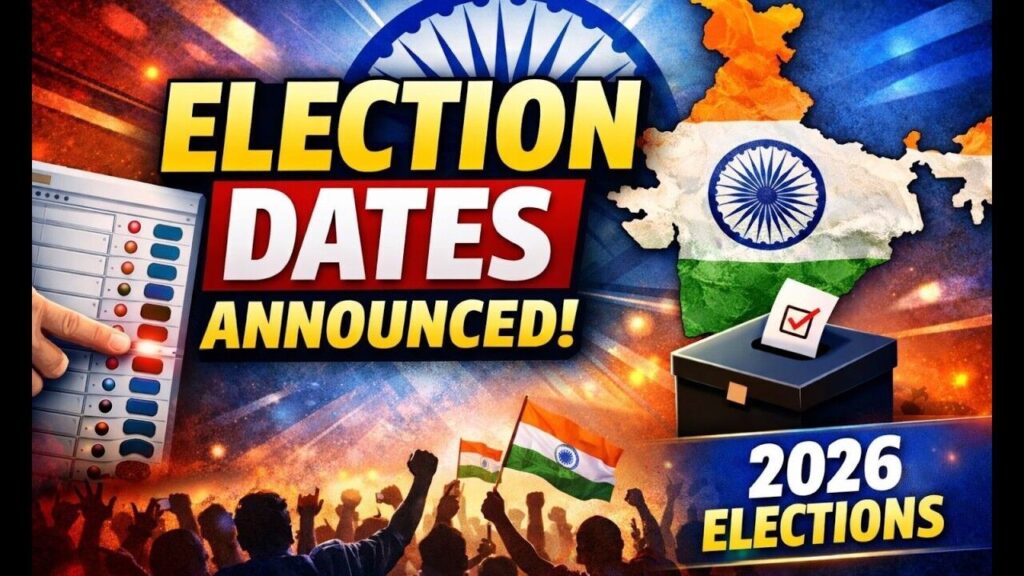
Election Date 2026: Upcoming Elections in India, Expected Schedule, States Voting and Key Political Developments
India, the world’s largest democracy, conducts elections regularly to ensure that citizens can choose their representatives. The 2026 election cycle in India is expected to be politically significant as several major states will head to the polls. These elections will play an important role in shaping the political landscape before the next national parliamentary contest.
According to constitutional provisions, elections are organized by the Election Commission of India, which is responsible for announcing official election dates, supervising voting procedures, and ensuring free and fair elections across the country.
In this article, we take a detailed look at the Election Date 2026, expected schedule, states going to polls, political significance, and the democratic process in India.
Election Date 2026: Expected Schedule

While the exact election dates are officially announced closer to polling time, the Election Commission of India typically schedules state elections based on the expiry of legislative assembly terms.
Several important states are expected to hold elections in April–May 2026, when their current assemblies complete their five-year terms.
Major States Expected to Hold Elections in 2026
| State | Current Assembly Term Ends | Expected Election Period |
|---|---|---|
| West Bengal | May 2026 | April–May 2026 |
| Tamil Nadu | May 2026 | April–May 2026 |
| Kerala | May 2026 | April–May 2026 |
| Assam | May 2026 | April–May 2026 |
| Puducherry | May 2026 | April–May 2026 |
These elections will involve millions of voters, thousands of candidates, and extensive election management operations across the states.
Why the 2026 Elections Are Important

The upcoming elections in 2026 are expected to be highly competitive because they will involve some of the most politically active states in India.
States like West Bengal, Tamil Nadu, and Kerala have historically witnessed intense political contests between regional and national parties.
These elections will also influence political strategies ahead of the next national parliamentary elections.
Key States Voting in 2026

West Bengal Assembly Election 2026
The West Bengal Assembly election is expected to be one of the most closely watched contests in the country.
The current government is led by Mamata Banerjee of the All India Trinamool Congress, which won a decisive victory in the 2021 elections.
Major political players expected to compete include:
-
Bharatiya Janata Party
-
All India Trinamool Congress
-
Indian National Congress
-
Left parties led by Communist Party of India (Marxist)
The outcome of this election will be crucial for the political balance in eastern India.
Tamil Nadu Assembly Election 2026
The southern state of Tamil Nadu is another major battleground in 2026.
The current government is led by M. K. Stalin from the Dravida Munnetra Kazhagam.
Tamil Nadu politics traditionally revolves around two major alliances:
-
Dravida Munnetra Kazhagam alliance
-
All India Anna Dravida Munnetra Kazhagam alliance
National parties such as the Bharatiya Janata Party and Indian National Congress also play important roles in state coalitions.
Kerala Assembly Election 2026

The state of Kerala will also vote in 2026.
The current government is led by Pinarayi Vijayan, representing the Communist Party of India (Marxist) under the Left Democratic Front.
Kerala politics generally features a two-front competition:
-
Left Democratic Front (LDF)
-
United Democratic Front (UDF) led by the Indian National Congress
The election outcome often determines the direction of policies in education, healthcare, and social welfare in the state.
Assam Assembly Election 2026
In northeastern India, Assam will also hold its assembly election.
The state is currently governed by Himanta Biswa Sarma from the Bharatiya Janata Party.
The election will likely see competition between:
-
BJP-led alliance
-
Congress-led opposition alliance
-
Regional parties
Assam elections often focus on issues such as development, migration, and regional identity.
Puducherry Assembly Election 2026
The union territory Puducherry will also elect a new legislative assembly in 2026.
Despite its smaller size, Puducherry’s elections attract attention due to frequent coalition politics and shifting alliances.
How Elections Are Conducted in India


Elections in India follow a structured democratic process overseen by the Election Commission of India.
Key Steps in the Election Process
-
Announcement of election schedule
-
Filing of nomination papers by candidates
-
Election campaigning by political parties
-
Polling using electronic voting machines
-
Counting of votes and declaration of results
India uses Electronic Voting Machine (EVM) technology to conduct voting efficiently across the country.
Role of Voters in the Democratic Process
India has over 900 million registered voters, making its election process the largest democratic exercise in the world.
Citizens above the age of 18 years are eligible to vote, as defined by the Constitution of India.
Voting allows people to:
-
Choose their representatives
-
Influence government policies
-
Strengthen democratic governance
High voter turnout is often considered a sign of strong democratic participation.
Political Significance of the 2026 Elections
The 2026 state elections will also have implications for national politics.
Political analysts believe the results could impact the strategies of national leaders, including Narendra Modi, whose party plays a major role in many state elections.
Regional parties will also try to strengthen their influence in their respective states.
Key issues likely to dominate the campaign include:
-
Economic growth
-
Employment opportunities
-
Infrastructure development
-
Welfare schemes
-
Education and healthcare
Election Security and Transparency

The Election Commission of India deploys extensive security arrangements during elections.
These measures include:
-
Central security forces
-
Polling station monitoring
-
Voter identification verification
-
Electronic voting security
Such steps help ensure that elections remain free, fair, and transparent.
Final Thoughts
The Election Date 2026 in India will mark another important chapter in the country’s democratic journey. With several key states including West Bengal, Tamil Nadu, Kerala, and Assam heading to the polls, the upcoming elections are expected to generate significant political interest.
As millions of voters prepare to cast their votes, the role of the Election Commission of India will be crucial in ensuring that the democratic process remains transparent and credible.
Ultimately, elections are the foundation of democracy, giving citizens the power to shape the future of their states and the nation.