

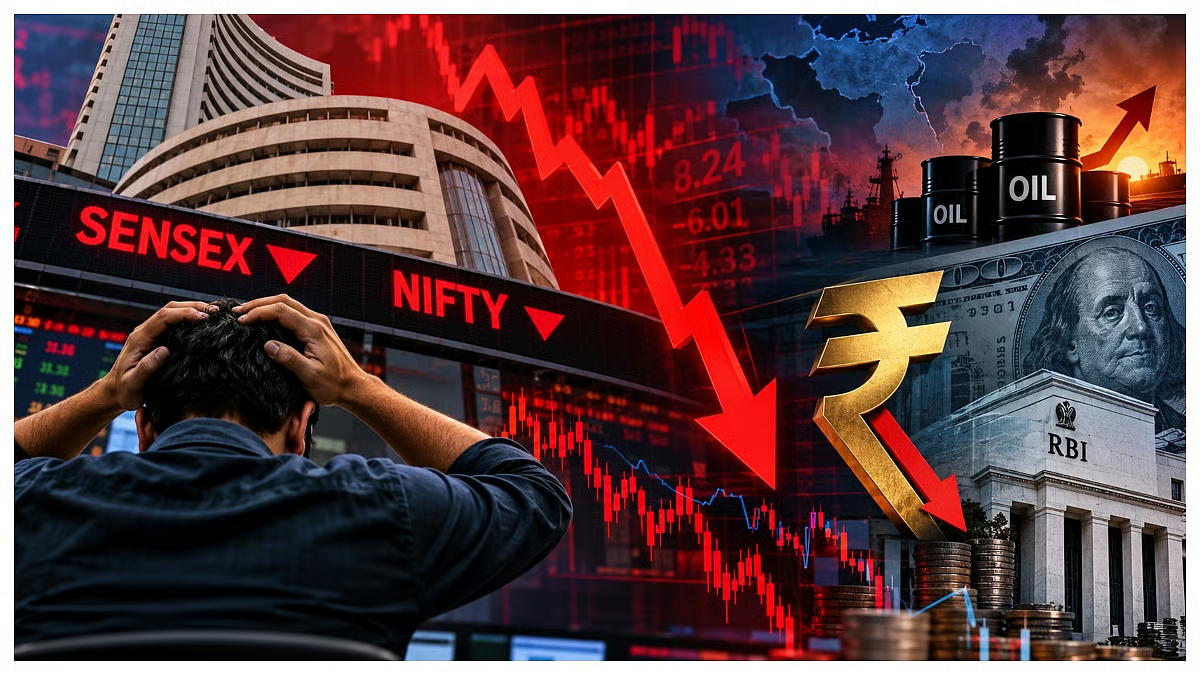
Stock Market Crash 2026: Why Sensex and Nifty Fell, Key Reasons Behind the Sell-Off and What Investors Should Know
Stock Market Crash: The Indian stock market has experienced significant volatility in October 2026, with benchmark indices facing sharp selling pressure before staging a strong recovery. Rising crude oil prices, foreign investor outflows, elevated global bond yields and concerns about inflation have weighed on sentiment. However, renewed buying in information technology (IT) shares and better-than-expected corporate earnings helped the market recover during the week ending October 16.
On October 8, the BSE Sensex plunged 1,045 points to close at 71,593, while the NSE Nifty 50 settled at 22,232 after falling sharply during the session. The market subsequently recovered, and on October 16, the Sensex closed at 74,729.27 while the Nifty ended at 23,146.15.
The recent movement highlights how quickly market sentiment can change when global economic concerns combine with domestic selling pressure. Here is a detailed look at the main reasons behind the stock market crash, the latest recovery, and the factors investors should watch next.
Stock Market Crash: Latest Sensex and Nifty Update
The Indian equity market faced a difficult start to October as investors reacted to rising borrowing costs, geopolitical tensions and continued selling by foreign portfolio investors.
| Market indicator | Latest reported update |
|---|---|
| Sensex, October 8 close | 71,593 |
| Nifty 50, October 8 close | 22,232 |
| Sensex, October 16 close | 74,729.27 |
| Nifty 50, October 16 close | 23,146.15 |
| Major recovery driver | IT stocks and earnings |
| Key concerns | Crude oil, bond yields, inflation and foreign selling |
Source: Business Standard and Reuters. Figures represent the specified trading dates, not live prices.
1. Rising Crude Oil Prices Put Pressure on Indian Stocks
One of the major concerns behind the recent stock market decline has been the increase in crude oil prices.
India imports a substantial share of its crude oil requirements. When international oil prices rise, the country’s import bill can increase, potentially putting pressure on the rupee, inflation and corporate profitability.
Higher fuel and transportation costs can affect industries such as aviation, logistics, paints, chemicals and manufacturing. Companies may face higher expenses, while consumers could have less money available for discretionary purchases.
Brent crude was reported around $105 per barrel on October 16. Although prices eased slightly during the session, they remained elevated amid geopolitical concerns in West Asia.
For investors, the direction of crude oil prices remains an important factor. A sustained decline could ease inflation concerns, while another sharp increase may put renewed pressure on Indian equities.

2. Foreign Investors Continue to Sell Indian Equities
Foreign portfolio investor (FPI) selling has been another major factor affecting market sentiment.
International investors often adjust their exposure to emerging markets according to global interest rates, currency movements, valuations and expected returns. When US assets become more attractive or global risks increase, some investors reduce their holdings in Indian shares.
A recent report from Value Research, citing NSDL data reported by Business Standard, said foreign portfolio investors had net sold approximately ₹3.08 lakh crore of Indian equities through October 12, 2026.
Persistent selling can affect large-cap stocks and create pressure across benchmark indices. It can also weaken sentiment among domestic traders, particularly when overseas investors sell heavily during already volatile sessions.
However, foreign selling does not automatically mean that the market must continue falling. Domestic institutional investors, including mutual funds and insurance companies, can absorb some of the supply. Corporate earnings and valuations also influence whether buyers return.
Investors can read more in this FPI selling analysis.
3. Higher Bond Yields Increase Market Uncertainty
Bond yields have also contributed to volatility in global financial markets.
Government bonds compete with equities for investor money. When bond yields rise, investors may demand stronger potential returns before buying stocks, especially companies whose valuations depend heavily on future growth.
Higher yields can also increase borrowing costs for businesses and governments. Companies that depend on debt financing may face additional interest expenses, potentially affecting future earnings.
In October, concerns about inflation and the possibility of tighter monetary policy contributed to pressure across global markets. Technology stocks, which are often sensitive to changes in interest-rate expectations, faced particular uncertainty.
If bond yields stabilise or decline, equity markets may find some relief. However, another rise could renew concerns about valuations and financing costs.
4. Inflation and Interest-Rate Concerns Weigh on Sentiment
Inflation remains a key risk for investors because it influences monetary policy, borrowing costs and consumer spending.
When inflation stays elevated, central banks may have less room to cut interest rates. If policymakers tighten financial conditions to control prices, borrowing can become more expensive for households and businesses.
The result can be a challenging environment for companies that rely on strong consumer demand or significant capital investment.
In India, higher crude oil prices could make the inflation outlook more complicated. Investors are therefore monitoring central-bank communication and economic data for clues about the future direction of interest rates.
Importantly, the market’s reaction depends not only on an actual policy decision but also on whether it differs from what investors had already expected.

5. Profit Booking and Technical Selling Accelerate the Fall
Market declines can become sharper when investors begin booking profits or when important technical levels are breached.
After a period of uncertainty, traders may reduce risk by selling shares, particularly when prices move below support levels. Stop-loss orders and the unwinding of leveraged positions can add to selling pressure.
During the October sell-off, the Sensex and Nifty recorded substantial declines, while market reports highlighted persistent foreign selling and concerns over bond yields and oil prices.
Such moves can appear sudden because several types of selling may happen together. However, a sharp fall does not necessarily mean that every company has experienced a similar deterioration in its business outlook.
Investors should distinguish between a temporary market-wide correction and a company-specific problem.
6. Global Technology Volatility Adds to the Uncertainty
Technology shares have been sensitive to changing expectations around artificial intelligence investment, earnings growth and financing costs.
Concerns about the sustainability of AI-related spending and high valuations have contributed to volatility in global technology markets. When international technology stocks weaken, investors may reassess exposure to related businesses elsewhere.
Yet the Indian market has also shown how quickly this pressure can reverse. During the week ending October 16, Indian IT shares staged a strong rebound after quarterly earnings from major companies helped improve sentiment.
Reuters reported that the Nifty 50 rose 2.8% over the week and the Sensex gained 3.1%. The Nifty IT index climbed 11.7%, its strongest weekly gain in 18 years, according to the report.
This recovery shows that global technology concerns can create risk, but company earnings can also become a powerful catalyst for renewed buying.
Read the latest Reuters market report.

Why Did the Stock Market Recover on October 15 and 16?
Despite the earlier crash, Indian shares recovered strongly during the second half of the week.
The key factor was renewed buying in IT stocks following quarterly earnings announcements. Shares of major technology companies, including TCS, Infosys, HCLTech and Tech Mahindra, benefited from improved sentiment.
Investors also responded to lower Treasury yields and measures aimed at supporting financial-market confidence. The rupee strengthened during the week, providing another positive signal.
Nevertheless, the recovery was not uniform. Some smaller stocks remained under pressure, and investors continued to monitor crude oil prices, inflation and foreign investment flows.
The rebound is encouraging, but two positive sessions alone cannot confirm that the market has entered a sustained upward trend.
Which Stocks and Sectors Should Investors Watch?
During periods of market volatility, sector performance can vary significantly.
| Sector | What investors should monitor |
|---|---|
| IT | Quarterly earnings, client spending and AI-related demand |
| Banking | Loan growth, deposit costs and asset quality |
| Oil and gas | Crude prices, refining margins and currency movements |
| Aviation | Fuel expenses and passenger demand |
| Automobiles | Consumer demand, input costs and financing conditions |
| Metals | Global commodity prices and demand from major economies |
| Consumer goods | Inflation, demand trends and pricing power |
These are monitoring categories, not buy recommendations. Individual companies within the same sector can perform very differently depending on their balance sheets, valuations and business outlook.
Will the Stock Market Crash Again?
No one can reliably predict whether another sharp fall will occur or when it might happen.
The near-term direction of the Indian market will depend on several factors: foreign investor activity, crude oil prices, global bond yields, inflation data and upcoming corporate earnings.
Banking-sector earnings are particularly important because large financial companies have a significant influence on benchmark indices. Investors will also be watching the proposed Jio Platforms IPO, which could affect market liquidity and investor allocation decisions.
A sustained recovery would be more convincing if it were supported by improving earnings, broader participation across sectors and reduced selling pressure. Conversely, renewed geopolitical tensions, higher oil prices or another increase in global yields could create fresh volatility.
What Should Retail Investors Do During a Market Crash?
Market corrections can be stressful, especially for investors who see the value of their portfolios decline in a short period. A disciplined approach can help avoid decisions driven by fear.
- Review your investment horizon: Short-term price movements may be less important for investors with a long-term plan, provided their original investment thesis remains valid.
- Avoid panic selling: Do not sell solely because headlines use the word “crash.” Review the underlying business and your financial needs first.
- Check company fundamentals: Revenue growth, profitability, debt and cash flow can help distinguish stronger businesses from weaker ones.
- Maintain diversification: Concentrating investments in one sector or a handful of stocks can increase risk.
- Keep emergency money separate: Funds needed for near-term expenses should not depend on stock-market recovery.
- Be careful with leverage: Borrowed money and leveraged trading can magnify losses during volatile sessions.
- Use a plan for fresh investments: Consider your risk tolerance, valuation and asset allocation rather than trying to identify the exact market bottom.
Investors should also remember that broad indices can recover even while some individual shares continue to fall. A market rebound is not a guarantee that every stock will return to its previous price.
Frequently Asked Questions (FAQs)

1. Why is the stock market crashing in October 2026?
Recent declines have been linked to foreign investor selling, elevated crude oil prices, higher global bond yields, inflation concerns and uncertainty around interest rates.
2. How much did the Sensex fall on October 8, 2026?
The Sensex closed at 71,593 after falling 1,045 points during the session.
3. What was the Nifty 50 closing level on October 8?
The Nifty 50 closed at approximately 22,232 on October 8, 2026.
4. Did the Indian stock market recover on October 16?
Yes. The Sensex closed at 74,729.27 and the Nifty 50 at 23,146.15 on October 16, according to Reuters.
5. Is foreign investor selling the only reason for the crash?
No. FPI outflows are one factor alongside crude oil prices, bond yields, inflation concerns, global sentiment and domestic market positioning.
6. Is this a good time to buy stocks?
That depends on your financial goals, investment horizon, risk tolerance and the valuation and fundamentals of each company. A market fall alone does not make every stock a bargain.
7. Will the Sensex and Nifty rise again?
A further recovery is possible, but it is not guaranteed. Earnings, global markets, oil prices and foreign investment flows will influence the direction.
Final Verdict
The October 2026 stock market crash highlights the impact of global financial conditions on Indian equities. Higher crude oil prices, persistent foreign investor outflows and elevated bond yields contributed to selling pressure, while strong IT earnings helped trigger a recovery later in the week.
For investors, the main lesson is to focus on fundamentals, diversification and risk management rather than reacting to every sharp market move. The recent rebound is a positive development, but market volatility may continue until the major economic and geopolitical uncertainties become clearer.
Disclaimer: This article is for news and educational purposes only and does not constitute investment advice. Stock-market investments are subject to risk. Consult a qualified financial adviser before making investment decisions.