

Hyundai Bayon Launched in India at ₹9.99 Lakh: Check Engine, Features, Safety and Specifications
Hyundai Bayon 2026: Hyundai Motor India has officially launched the new Hyundai Bayon SUV on October 26, 2026, introducing a technology-focused model aimed at buyers looking for modern styling, advanced safety and connected-car features. The SUV arrives with an introductory starting price of ₹9,99,900 (ex-showroom), a 1.5-litre petrol engine and a choice of manual and automatic transmissions.
The new Hyundai Bayon is expected to attract families, urban commuters and customers planning to upgrade to a feature-rich SUV. Its major highlights include dual 12.3-inch displays, a generative AI voice assistant, Hyundai SmartSense Level 2 Pro ADAS and more than 70 connected-car features.
With this launch, Hyundai is expanding its SUV portfolio in India and offering another option for buyers who prioritise technology, comfort and everyday practicality.
Hyundai Bayon 2026: Price and Launch Details
Hyundai has introduced the Bayon in India at an introductory ex-showroom price of ₹9.99 lakh. The company has also opened bookings through its official website and authorised dealerships, with a booking amount of ₹11,000.
The SUV is positioned as a technology-oriented offering in Hyundai’s growing domestic lineup. Its combination of digital features, petrol performance and driver-assistance technology is designed to appeal to customers seeking a contemporary driving experience.
The introductory price is an important part of the Bayon’s launch strategy. However, buyers should check the latest official variant-wise price list, insurance costs, registration charges and available offers before making a purchase decision.
Hyundai Bayon Engine and Performance
The Hyundai Bayon is powered by a four-cylinder, 1.5-litre naturally aspirated MPi petrol engine. It produces 115 PS of maximum power and 143.8 Nm of peak torque.
Customers can choose between a six-speed manual gearbox and Hyundai’s Intelligent Variable Transmission (iVT) automatic. This gives buyers the flexibility to select a conventional manual driving experience or an automatic option for daily traffic conditions.
The engine specifications are listed below:
| Specification | Hyundai Bayon |
|---|---|
| Engine | 1.5-litre MPi petrol |
| Cylinders | Four |
| Maximum power | 115 PS |
| Peak torque | 143.8 Nm |
| Manual gearbox | Six-speed |
| Automatic gearbox | Intelligent Variable Transmission (iVT) |
| Drive modes | Eco, Normal, Sport |
| Fuel type | Petrol |
The iVT automatic variant receives additional driving technologies, including Dash Boost Mode and Sporty Drive Tech. These systems are designed to improve throttle response and make acceleration feel more responsive during overtaking.
The SUV also features steering-mounted drive-mode controls and paddle shifters. Drivers can switch between Eco, Normal and Sport modes according to their preferences and road conditions.
Official fuel-efficiency figures should be checked against the final published specifications for the chosen variant before comparing the Bayon with competing vehicles.

Exterior Design: Modern SUV Styling
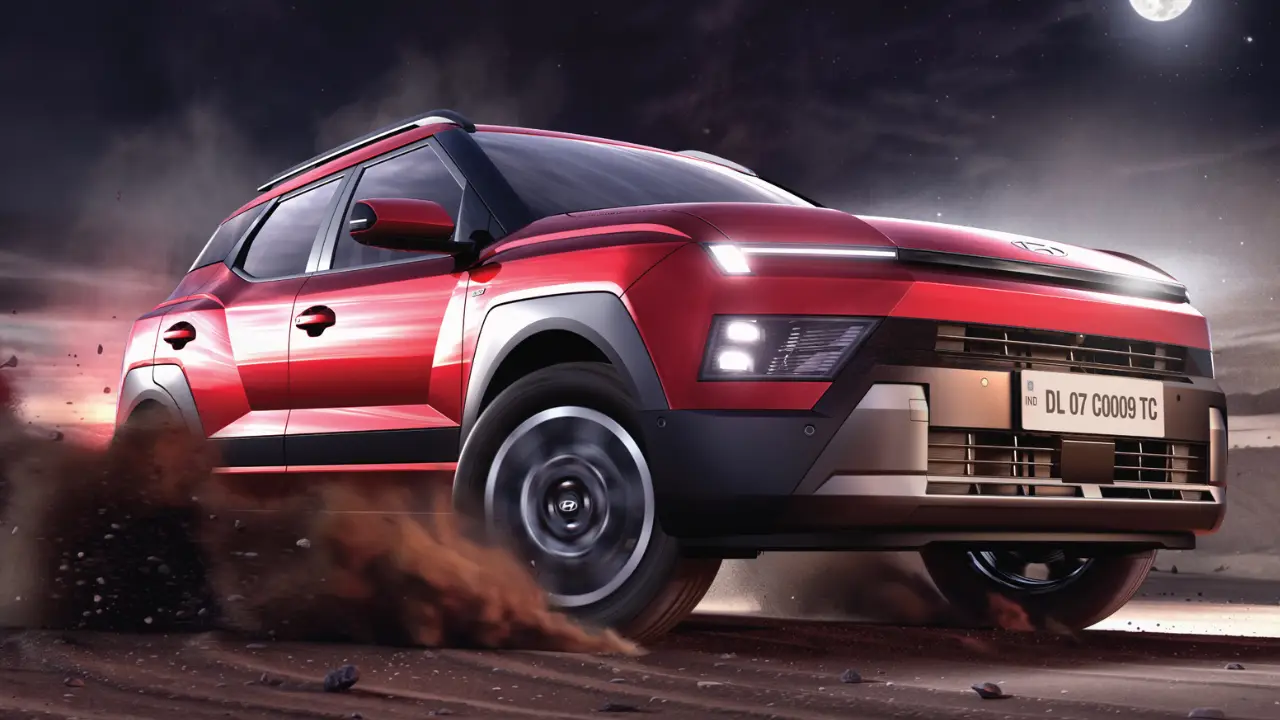
The Hyundai Bayon features a contemporary exterior with a sculpted bonnet, prominent wheel arches and distinctive lighting elements. Its front design incorporates H-Edge LED daytime running lights and dual LED projector headlamps, giving the vehicle a recognisable road presence.
The side profile features body cladding, bridge-style roof rails and diamond-cut alloy wheels on selected variants. These elements contribute to its SUV-inspired appearance while maintaining a design suited to urban use.
At the rear, H-Edge LED tail lamps and a sporty roof spoiler complete the exterior styling. Hyundai is offering the model in multiple colour options, including monotone, matte and dual-tone finishes.
The announced colour choices include Titanium Black, Classy Blue, Atlas White, Fiery Red, Golden Bronze and Ecotronic Grey. Dual-tone options include Atlas White with a black roof and Fiery Red with a black roof. Matte finishes are also available.
Actual colour and wheel availability may vary by variant.
Interior and Comfort Features
Inside, the Hyundai Bayon focuses on digital convenience, passenger comfort and everyday usability. Its dashboard features two curved 12.3-inch displays, combining the instrument cluster and infotainment functions in a modern cockpit layout.
The infotainment system integrates navigation and connected services, while wireless Android Auto and Apple CarPlay support smartphone connectivity. A Bose premium sound system is also listed among the available features.
Other equipment announced for the SUV includes:
- Ventilated front seats
- An eight-way electrically adjustable driver’s seat
- Rear AC vents
- Automatic climate control
- A panoramic sunroof
- Wireless smartphone charging
- USB Type-C charging ports
- Push-button start and smart-key functionality
- Rear centre armrest with cupholders
- 60:40 split rear seats
These features are intended to make the Bayon suitable for daily commuting and longer family journeys. Buyers should confirm which features are included in each trim before booking.
Hyundai also lists a 505-litre boot capacity, giving the SUV practical luggage space for shopping, airport transfers and weekend travel.

Generative AI Voice Assistant and Connected Technology
One of the biggest highlights of the Hyundai Bayon is its generative AI voice assistant, introduced as a first for Hyundai Motor India. The technology combines intelligence from Perplexity with voice AI powered by SoundHound AI.
The assistant is designed to make vehicle interactions more conversational. Depending on the supported service and available connectivity, users can request travel itineraries, weather updates, restaurant recommendations, hotel information, news and sports information.
The system is supported by Hyundai’s Connected Car Navigation Cockpit, accelerated by NVIDIA. Its dual-screen arrangement aims to make navigation, driving information and entertainment easier to access.
The SUV also offers more than 70 Hyundai Bluelink connected features and more than 500 embedded voice commands. Selected voice functions can operate without an internet connection.
The interface supports 10 regional languages and two international languages, while embedded voice commands are available in English, Hindi, Hinglish, Tamil, Bengali and Telugu, according to the announced specifications.
Over-the-air updates for supported vehicle controllers are another important addition. These updates can help deliver software improvements without requiring every supported update to be installed through a conventional workshop visit.
Hyundai Bayon Safety Features and ADAS
Safety is another major focus of the new SUV. Hyundai says the Bayon offers more than 80 advanced safety features, including its SmartSense Level 2 Pro advanced driver-assistance system with 23 driver-assistance functions.
The announced assistance technologies include:
- Forward collision warning and avoidance assistance
- Lane-keeping assistance
- Adaptive cruise control with stop-and-go functionality
- Highway Driving Assist
- Blind-spot monitoring and assistance
- Navigation-based smart cruise-control functions
- Surround-view monitoring
- Blind-spot view monitoring
The availability of individual systems may differ according to variant and configuration.
Standard safety equipment includes six airbags, electronic stability control, hill-start assist, a tyre-pressure monitoring system and ISOFIX child-seat mounts. Hyundai also lists all-wheel disc brakes and parking assistance technologies among the Bayon’s equipment, depending on the version.
Driver-assistance systems are designed to support the driver rather than replace attentive driving. Buyers should understand the limitations of these features and verify the exact equipment included in their chosen variant.
Hyundai Bayon Dimensions and Practicality
The Bayon measures 4,245 mm in length, 1,810 mm in width and 1,605 mm in height with roof rails. Its wheelbase measures 2,600 mm, while the company lists ground clearance at 205 mm.
| Dimension | Measurement |
|---|---|
| Length | 4,245 mm |
| Width | 1,810 mm |
| Height with roof rails | 1,605 mm |
| Wheelbase | 2,600 mm |
| Ground clearance | 205 mm |
| Boot capacity | 505 litres |
| Fuel tank capacity | 43 litres |
These dimensions give the vehicle a substantial footprint for urban driving while offering useful luggage capacity. Nevertheless, buyers should test rear-seat comfort, visibility and parking convenience in person, particularly if the SUV will regularly be used on narrow streets or in crowded parking areas.
Hyundai Bayon vs Other Hyundai SUVs
The Bayon adds another choice to Hyundai’s Indian SUV range. Buyers considering it may also compare it with the Hyundai Venue and Hyundai Creta.
The Venue is worth considering for customers prioritising a smaller footprint, while the Creta remains an alternative for those seeking a different size and equipment combination. The Bayon distinguishes itself through its announced generative AI assistant, dual large displays and Level 2 Pro ADAS package.
A meaningful comparison should include the final on-road price, variant-level equipment, fuel efficiency, rear-seat space, service costs and warranty coverage rather than relying on starting prices alone.
Should You Buy the Hyundai Bayon 2026?
The Hyundai Bayon looks like a compelling option for buyers who value modern infotainment, connected services, advanced driver assistance and a well-equipped cabin. Its 115 PS petrol engine and manual or iVT transmission choices offer flexibility for different driving preferences.
The dual-screen cockpit, generative AI voice assistant, panoramic sunroof, ventilated front seats and extensive safety equipment are among its strongest selling points. The introductory price of ₹9.99 lakh also gives buyers a clear starting point for evaluating the new SUV.
However, the final decision should depend on the exact variant, on-road price, real-world fuel consumption, comfort during a test drive and the long-term cost of ownership. Customers who regularly travel long distances should also compare the vehicle’s highway performance and fuel costs with alternative SUVs.

Conclusion
The Hyundai Bayon 2026 has arrived in India with a starting price of ₹9.99 lakh (ex-showroom), a 1.5-litre petrol engine producing 115 PS and a technology-rich equipment package. Its generative AI voice assistant, dual 12.3-inch displays, connected-car functions and Level 2 Pro ADAS give it a distinctive position in Hyundai’s SUV portfolio.
For buyers planning to purchase a new SUV, the Bayon deserves consideration alongside other models in its price range. Checking the official variant list, booking terms, on-road quotation and test-drive experience will help determine whether it is the right choice.