


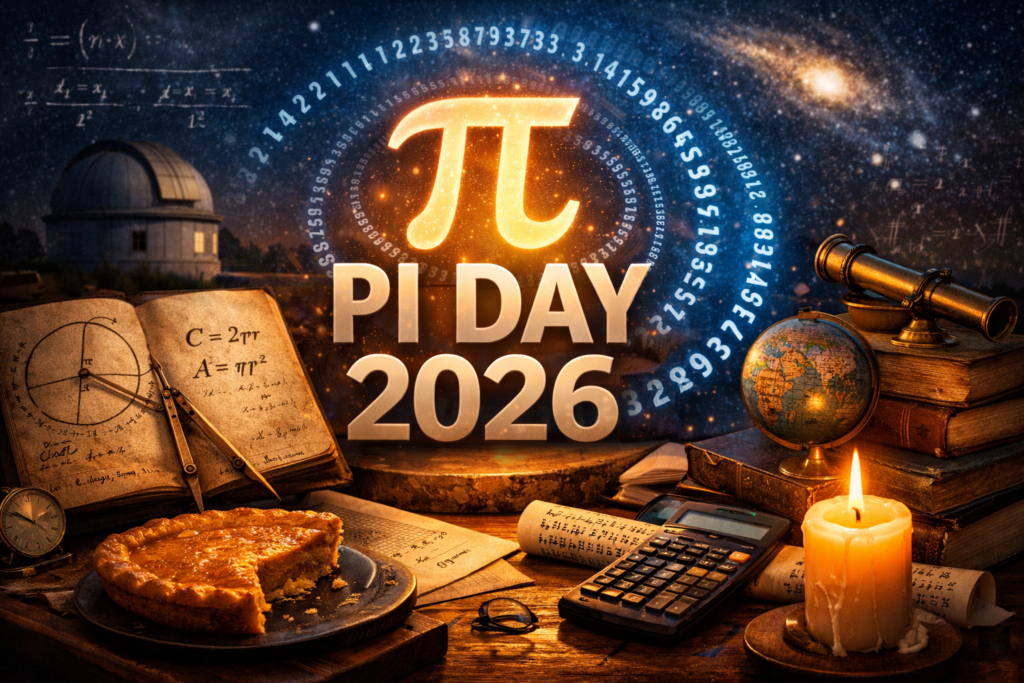
Pi Day 2026: Significance of the Mathematical Constant π and Why the World Celebrates It
Every year on March 14, math enthusiasts, scientists, teachers, and students across the globe celebrate Pi Day, a special occasion dedicated to the mathematical constant π (Pi). In 2026, the celebration of Pi Day continues to highlight the importance of mathematics in science, engineering, and everyday life.
Pi Day is not only about numbers and formulas; it is also about curiosity, discovery, and the beauty of mathematics. The date 3/14 represents the first three digits of π — 3.14 — which is why this day has become globally recognized as Pi Day.
In this article, we explore the history of Pi Day, the significance of π, its applications in real life, and how people around the world celebrate Pi Day 2026.
What is Pi (π)?

The mathematical constant π (Pi) represents the ratio of the circumference of a circle to its diameter. This ratio remains constant for every circle, regardless of its size.
\pi = \frac{C}{d}
Where:
-
C = Circumference of the circle
-
d = Diameter of the circle
The approximate value of π is:
π ≈ 3.14159
However, π is an irrational number, meaning its decimal representation continues infinitely without repeating.
Scientists have calculated trillions of digits of π, but in most practical applications, only a few digits are required.
Why Pi Day is Celebrated on March 14

Pi Day is celebrated on March 14 (3/14) because the date matches the first three digits of π.
Interestingly, March 14 is also the birthday of legendary physicist Albert Einstein, making the day even more special for science lovers.
In 2019, the UNESCO officially declared March 14 as the International Day of Mathematics, further strengthening the importance of Pi Day worldwide.
History of Pi Day
The modern celebration of Pi Day began in 1988 at the San Francisco Exploratorium, a famous science museum in the United States.
The event was organized by physicist Larry Shaw, who is widely known as the “Prince of Pi.”
The celebration included:
-
Marching in circles
-
Eating pies
-
Discussing mathematical concepts
Over the years, Pi Day gained popularity among schools, universities, and science organizations worldwide.
Later, in 2009, the United States House of Representatives officially recognized Pi Day, helping it gain international attention.
Importance of Pi in Mathematics

Pi is one of the most important constants in mathematics and appears in various formulas involving circles, spheres, and waves.
Circumference of a Circle
Where r is the radius of the circle.
Area of a Circle
These formulas are fundamental in geometry and are used in numerous real-world calculations.
Applications of Pi in Real Life

Although π may appear to be a theoretical concept, it plays a crucial role in many real-world fields.
1. Engineering and Construction
Engineers use π when designing:
-
Bridges
-
Wheels
-
Pipes
-
Buildings
Whenever circular measurements are involved, π becomes essential.
2. Space Science and Astronomy
Space agencies like NASA use π in calculations related to:
-
Planetary orbits
-
Satellite trajectories
-
Spacecraft navigation
Without π, accurate space missions would be impossible.
3. Physics
In physics, π appears in formulas related to:
-
Waves
-
Electromagnetism
-
Quantum mechanics
Many scientific equations rely on π to describe natural phenomena.
4. Computer Science and Data Analysis
Pi is used in algorithms, simulations, and complex computational models.
Supercomputers often calculate trillions of digits of π to test processing power and accuracy.
Famous Mathematicians Who Worked on Pi

Throughout history, several mathematicians have contributed to understanding and calculating π.
Archimedes
Archimedes was one of the first mathematicians to estimate the value of π using polygons. His calculations placed π between 3.1408 and 3.1429, which was extremely accurate for his time.
Leonhard Euler
Euler popularized the symbol π for this mathematical constant in the 18th century. Since then, π has become universally recognized in mathematics.
William Jones
William Jones first introduced the Greek letter π in 1706 to represent the constant ratio of a circle’s circumference to its diameter.
Record-Breaking Pi Calculations
With advances in technology, mathematicians and computer scientists have calculated trillions of digits of π.
High-performance computers and supercomputing systems are often used to push these limits.
Calculating π to extreme precision helps:
-
Test computer hardware
-
Develop new algorithms
-
Improve numerical analysis
How Pi Day 2026 is Celebrated
Pi Day is celebrated with enthusiasm in schools, universities, and science centers around the world.
Here are some common Pi Day activities:
1. Pi Recitation Competitions
Students compete to memorize and recite the maximum number of digits of π.
The current record holders have memorized tens of thousands of digits.
2. Pie-Eating Celebrations
Because “Pi” sounds like “Pie,” people celebrate by eating different types of pies.
This fun tradition makes math more enjoyable and engaging.
3. Math Workshops and Events
Educational institutions organize:
-
Mathematics quizzes
-
STEM workshops
-
Coding competitions
These events help students appreciate the beauty of mathematics.
4. Online Celebrations
Social media platforms see a surge of Pi-related posts, puzzles, and challenges every year.
Educational platforms also release math-based games and activities.
Pi Day and the Future of Mathematics


Pi Day continues to inspire new generations of mathematicians, engineers, and scientists.
Mathematics plays a key role in solving modern challenges such as:
-
Artificial intelligence
-
Climate modeling
-
Space exploration
-
Medical technology
Constants like π form the foundation of these advanced scientific fields.
Interesting Facts About Pi
Here are some fascinating facts about π:
-
π is an irrational number, meaning it never ends and never repeats.
-
Mathematicians have calculated over 100 trillion digits of π.
-
March 14 at 1:59 PM is called Pi Minute, representing the digits 3.14159.
-
π appears in many formulas beyond geometry, including probability and statistics.
Pi Day in Education
Teachers around the world use Pi Day to make mathematics exciting for students.
Activities often include:
-
Measuring circular objects
-
Solving math puzzles
-
Exploring geometry concepts
-
Learning the history of mathematics
These interactive experiences help students understand how math works in real life.
Conclusion
Pi Day 2026 is more than just a celebration of a mathematical constant — it is a tribute to the power of mathematics in shaping our world.
The constant π plays a fundamental role in science, engineering, physics, and technology. From ancient mathematicians like Archimedes to modern researchers using supercomputers, the fascination with π continues to grow.
By celebrating Pi Day, people across the globe acknowledge the importance of mathematics and inspire future innovators to explore the wonders of numbers.
As we mark March 14, 2026, Pi Day reminds us that even a simple ratio discovered thousands of years ago can unlock countless mysteries of the universe