



Why Stock Market Crashed Today? Sensex, Nifty50 Plunge In Final Hours Of Trade; Here Are The Key Reasons Behind Market Fall
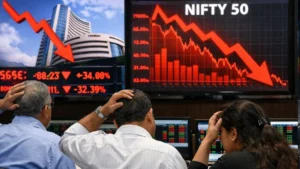
The Indian stock market suffered a major decline today as benchmark indices Sensex and Nifty50 witnessed heavy selling pressure during the final trading hours. Investors were shocked after the market, which initially showed signs of stability, suddenly turned extremely volatile and ended sharply lower.
The late-session sell-off wiped out significant investor wealth and dragged almost all major sectors into the red. Banking, IT, auto, metal, and energy stocks witnessed strong profit booking, while midcap and smallcap stocks also faced heavy correction.
The sharp fall has once again raised concerns among retail investors regarding market volatility and near-term economic uncertainty.

Sensex and Nifty50 Close Deep in Red
The BSE Sensex crashed several hundred points during the final phase of trading, while the NSE Nifty50 slipped below important support levels. Market experts believe the decline was caused by a combination of domestic and global factors.
The market remained under pressure throughout the second half of the session, but selling intensified sharply during the final hour. Investors rushed to book profits after recent market highs, resulting in widespread weakness across sectors.
The India VIX, often called the fear index, also moved higher, indicating growing nervousness among traders.
Key Reasons Why Stock Market Crashed Today

1. Heavy Foreign Institutional Investor (FII) Selling
One of the biggest reasons behind today’s market crash was aggressive selling by Foreign Institutional Investors (FIIs).
Global investors have been reducing exposure to emerging markets due to uncertainty surrounding global interest rates, inflation concerns, and geopolitical tensions. FIIs continued their selling trend in Indian equities, especially in banking and IT stocks.
Since foreign investors hold a large share in Indian markets, continuous outflows often create panic among domestic traders and retail investors.
The sell-off became stronger during the final hours of trade as institutional investors reduced positions ahead of global market events.
2. Weak Global Market Cues
Global markets also remained weak today, negatively impacting investor sentiment in India.
Asian markets traded under pressure due to concerns regarding slowing global growth and uncertainty in the US economy. European markets also opened weak, increasing pressure on Indian equities during the afternoon session.
Concerns over rising bond yields and the possibility of prolonged high interest rates by major central banks affected risk appetite globally.
Investors usually avoid risky assets like equities when global uncertainty rises, which directly impacts emerging markets such as India.
3. Profit Booking After Recent Rally
Indian stock markets had witnessed a strong rally in recent sessions, with Sensex and Nifty trading near record levels.
After such sharp gains, traders often book profits to secure returns. Today’s correction appears to be partially driven by profit booking, especially in sectors that had outperformed recently.
Banking, auto, and technology stocks witnessed sharp declines as investors locked in gains.
Market analysts say short-term traders preferred reducing exposure ahead of upcoming economic data and global market developments.
4. Rising Crude Oil Prices


Another important factor behind today’s market weakness was the rise in crude oil prices.
Higher crude oil prices are generally negative for the Indian economy because India imports a large portion of its energy requirements. Rising oil prices increase inflation risks and can worsen the country’s trade deficit.
Sectors like aviation, paints, logistics, and oil marketing companies usually face pressure when crude prices rise sharply.
Investors fear that prolonged high crude prices may impact corporate earnings and economic growth.
5. Weakness in Banking and IT Stocks
Banking and IT stocks were among the biggest contributors to today’s market crash.
Private banking stocks witnessed strong selling pressure due to concerns regarding margin pressure and global uncertainty. IT stocks also declined sharply because of fears of slowdown in US demand and weak technology spending.
Since banking and IT sectors carry heavy weightage in Sensex and Nifty50, weakness in these sectors dragged benchmark indices lower.
Major frontline stocks witnessed heavy intraday volatility during the last trading hour.


6. Expiry-Related Volatility
Market experts also pointed to derivative expiry-related volatility as a reason behind the sudden crash.
During expiry sessions, traders aggressively adjust futures and options positions, which can result in sharp price swings. High volatility was visible in index futures and options during the final trading hours.
Algorithmic trading and stop-loss triggers further accelerated the market decline.
Retail investors were caught off guard as the fall became sharper within a short period.
7. Geopolitical Tensions and Economic Uncertainty
Global geopolitical concerns continue to create uncertainty in financial markets.
Investors remain cautious regarding ongoing international conflicts, trade tensions, and concerns surrounding global economic growth. Any rise in geopolitical risk usually impacts investor confidence and increases volatility in equity markets.
Safe-haven assets like gold and US bonds witnessed buying interest while equities remained under pressure.
Sector-Wise Performance Today


Almost all major sectors ended in the red today.
Banking Sector
Banking stocks witnessed heavy selling pressure due to profit booking and foreign investor outflows.
IT Sector
Technology stocks declined sharply following weak global tech sentiment and concerns regarding US economic slowdown.
Auto Sector
Auto shares also corrected after recent gains, though long-term demand outlook remains positive.
Metal Stocks
Metal companies came under pressure due to concerns over slowing global industrial demand.
Midcap and Smallcap Stocks
Broader markets also witnessed sharp correction, indicating widespread selling activity across the market.
What Should Investors Do Now?
Market experts believe investors should avoid panic selling during volatile sessions.
Short-term corrections are common in equity markets, especially after strong rallies. Long-term investors are advised to focus on quality companies with strong fundamentals instead of reacting emotionally to daily market movements.
Experts also suggest maintaining diversified portfolios and avoiding excessive leverage during uncertain market conditions.
Systematic investment plans (SIPs) remain one of the safest strategies for long-term wealth creation despite short-term market volatility.
Is This a Temporary Correction or Bigger Market Crash?

Most analysts currently view the fall as a healthy market correction rather than a major long-term crash.
India’s economic growth outlook remains relatively strong compared to many global economies. Corporate earnings, infrastructure spending, and domestic consumption continue to support the long-term growth story.
However, near-term volatility may continue due to global economic uncertainty, interest rate concerns, crude oil price movement, and foreign investor activity.
Investors are advised to monitor upcoming US Federal Reserve decisions, inflation data, and global market trends carefully.
Conclusion
Today’s stock market crash was triggered by multiple factors including FII selling, weak global cues, profit booking, rising crude oil prices, and sectoral weakness in banking and IT stocks.
The sudden sell-off during the final hours of trade created panic among investors, but analysts believe such corrections are part of normal market cycles.
While short-term volatility may continue, India’s long-term economic fundamentals remain strong. Investors with disciplined strategies and long-term vision are likely to benefit despite temporary market fluctuations.