


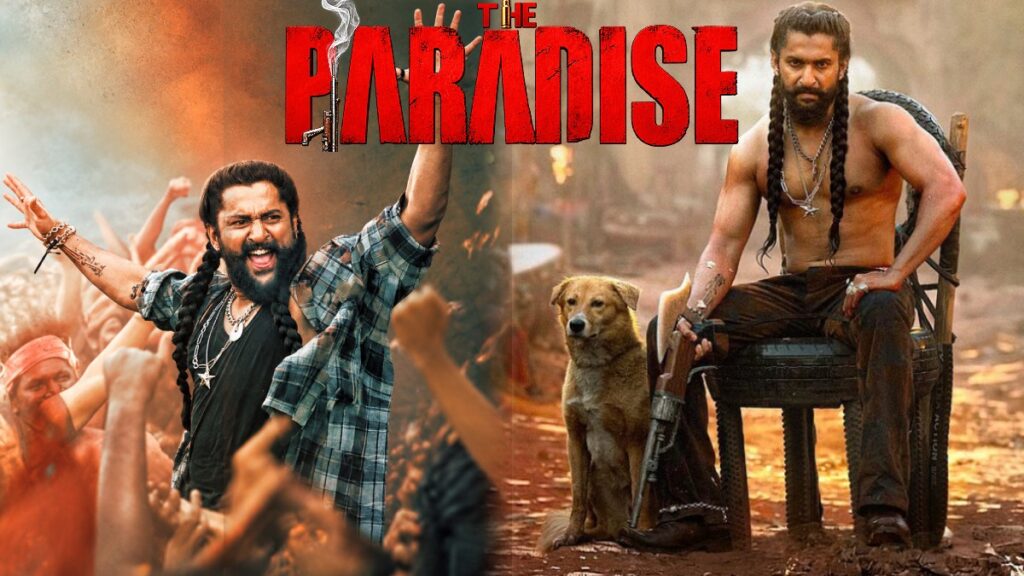
The Paradise Movie Review: Nani Shines in Srikanth Odela’s Ambitious Action Drama
The Paradise movie review: Nani and director Srikanth Odela have reunited after Dasara for a much bigger and more ambitious action drama. Released in theatres on September 24, 2026, The Paradise takes viewers into the world of the Savari community in 1980s Secunderabad, combining action, social conflict, violence and a story about identity and dignity.
The film stars Nani, Mohan Babu, Sonali Kulkarni, Kayadu Lohar and Raghav Juyal, with Srikanth Odela directing. Anirudh Ravichander has composed the music. The film has a reported runtime of 2 hours and 54 minutes and has received an A certificate.
The expectations surrounding The Paradise were particularly high because of the Nani-Srikanth Odela combination. Their first collaboration, Dasara, established a strong mass-action identity for the director and gave Nani another memorable rugged character.
But does The Paradise deliver the same impact?

The Paradise Movie Story
The Paradise is set in 1980s Secunderabad and centres on the Savari community, a marginalised group struggling for identity, dignity and recognition.
Nani plays Jadal, a character who returns from prison and finds himself back in a society controlled by powerful forces. Mohan Babu plays Malik, a dominant figure whose influence extends across the community.
As Jadal becomes increasingly involved in the struggles surrounding him, his personal journey develops into a larger fight against an oppressive system. The film uses this conflict to explore questions of identity, social position and collective resistance.
The basic premise gives Srikanth Odela plenty of material for an intense period action drama. The filmmaker attempts to create a distinct world rather than simply presenting another conventional commercial action story.
However, this is also where some critics felt the movie does not completely fulfil its potential.

Nani’s Performance in The Paradise
Nani is one of the strongest elements of the film.
The actor undergoes a significant physical and stylistic transformation for Jadal. Critics have particularly noted his altered appearance, including his hairstyle, beard, body language and physicality.
The Indian Express gave the film 2 out of 5, while specifically praising Nani’s physical transformation and committed performance. Its review argued that the actor’s effort is evident in the action sequences, even though the screenplay around him does not consistently match that commitment.
Nani approaches Jadal with a considerably more aggressive screen presence than audiences might associate with some of his earlier performances.
His body language helps establish the character’s rough surroundings, while the action scenes allow him to embrace the film’s mass-oriented presentation.
For Nani fans, his performance is likely to be one of the primary reasons to watch the film.
Srikanth Odela’s Direction


Srikanth Odela once again creates a gritty Telangana setting.
His world-building is among the film’s more noticeable features. The director attempts to immerse the audience in the social environment of the Savari community while combining period details with large-scale action.
Moneycontrol’s review highlighted the film’s ambitious world-building and gritty atmosphere, particularly in its early portions. However, the review also felt that the screenplay loses its grip in the second half as the narrative relies increasingly on violence instead of developing the central emotional conflict.
This creates an uneven experience.
The film clearly wants to be larger than a straightforward revenge or action story, but its different themes do not always come together smoothly.
The Paradise Screenplay
The screenplay is one of the biggest talking points in the early reviews.
The Indian Express described the film as relying on a familiar template despite Nani’s strong performance. The review suggested that the story does not consistently provide the freshness or emotional impact required to make the ambitious setting work.
Hindustan Times was even more critical, giving the movie 1 out of 5 and arguing that the film feels familiar while failing to maintain engagement. Its review also noted the connection to Telangana’s cultural and historical legacy.
At the same time, the premise itself gives The Paradise something interesting to explore.
The film is not simply about an individual hero fighting a villain. It attempts to connect Jadal’s personal journey with the larger problems faced by his community.
The challenge is that the screenplay sometimes prioritises spectacle over the emotional development of those ideas.
Action and Violence
Action is a major part of The Paradise.
The film has been designed as a raw, intense mass entertainer, and the violence is considerably stronger than what audiences might expect from a conventional Nani drama.
Filmfare described the movie as a violent mass drama with considerable scale and fury, while also arguing that it sometimes lacks emotional weight.
The action sequences benefit from Nani’s physical transformation. His performance gives the fights an added sense of physical commitment.
However, the heavy use of violence can also affect the pacing.
Some reviews have suggested that the film becomes increasingly dependent on violent set pieces as it moves forward, reducing the space available for its emotional and social themes.
Music and Background Score


Anirudh Ravichander handles the music for The Paradise, adding another major name to the project.
The background score is designed to support the film’s aggressive tone and large-scale action sequences.
Early review roundups have identified Anirudh’s music and background score among the elements that work in the film.
The music therefore plays an important role in establishing the atmosphere of the movie.
Rather than functioning only as conventional song sequences, the sound design and score contribute to the larger mass-action presentation.
Mohan Babu and Supporting Cast
Mohan Babu plays an important role as Malik, a powerful figure within the film’s social structure.
His character provides the authority against which Jadal’s rebellion develops.
Sonali Kulkarni, Kayadu Lohar and Raghav Juyal are also part of the principal cast.
The supporting performances help populate the film’s world, although some reviews have questioned whether all the characters receive enough development.
This is partly connected to the screenplay’s focus on Jadal and its large-scale conflicts.
The Paradise First Half vs Second Half
The first half appears to be one of the more effective sections of the film.
The world-building, character introduction and atmosphere establish a strong foundation. Jadal’s return and his position within the community provide the story with a clear direction.
The second half is where the response becomes more divided.
Moneycontrol noted that the film begins strongly but loses focus later, while several other reviews pointed to the screenplay becoming less cohesive.
This makes the film feel somewhat uneven despite its scale.
The 2-hour-54-minute runtime also means that pacing becomes an important consideration.
The Paradise Movie Review: What Works
There are several elements that stand out:
- Nani’s physical transformation
- Nani’s committed performance as Jadal
- Gritty 1980s Secunderabad setting
- Ambitious world-building
- Large-scale action sequences
- Strong production design and visual atmosphere
- Anirudh Ravichander’s background score
- A socially focused premise
- Strong mass moments for Nani fans
The film’s ambition is evident throughout.
It attempts to combine period drama, social commentary and commercial action rather than limiting itself to one genre.
The Paradise Movie Review: What Doesn’t Work


The biggest concerns raised by critics revolve around the screenplay.
Some reviews have described the story as familiar and fragmented, while others have criticised the movie for losing emotional focus as the violence increases.
The main criticisms include:
- Familiar storytelling
- Uneven screenplay
- Excessive violence
- Limited emotional depth in places
- Pacing problems
- Characters that could have received greater development
- A second half that loses some of the impact established earlier
These criticisms are important because the film’s premise promises more than a conventional action spectacle.
The Paradise Movie Rating
Early reviews have produced mixed ratings.
The Indian Express rated The Paradise 2/5, while Times of India gave it 2.5/5. Hindustan Times published a 1/5 rating, and India Today also rated it 2/5.
The common thread across these reviews is that Nani’s performance and the film’s scale receive appreciation, while the screenplay and execution attract criticism.
Because the movie has only just released, audience reactions and ratings can continue to change as more viewers watch it.


The Paradise Movie Review: Final Verdict
The Paradise is clearly an ambitious film.
Srikanth Odela attempts to build a large, gritty world around the Savari community while giving Nani a physically demanding and aggressive character in Jadal. The production scale, action and music help create the atmosphere of a major theatrical event.
Nani remains one of the film’s strongest assets. His transformation and commitment are visible, particularly in the action portions.
However, the early critical response indicates that the film’s screenplay and emotional cohesion do not always match its ambition. The first half establishes an intriguing world, but the narrative reportedly becomes more dependent on violence and familiar action-drama conventions as it progresses.
For viewers looking primarily for a Nani-led mass action spectacle, the film offers plenty of scale and intensity. Those expecting the social themes and character drama to receive equally strong development may find the execution less consistent.
With The Paradise, Srikanth Odela has clearly aimed bigger after Dasara. The result is a film that has ambition, atmosphere and a committed lead performance, but early reviews suggest that its storytelling does not consistently reach the same level.