

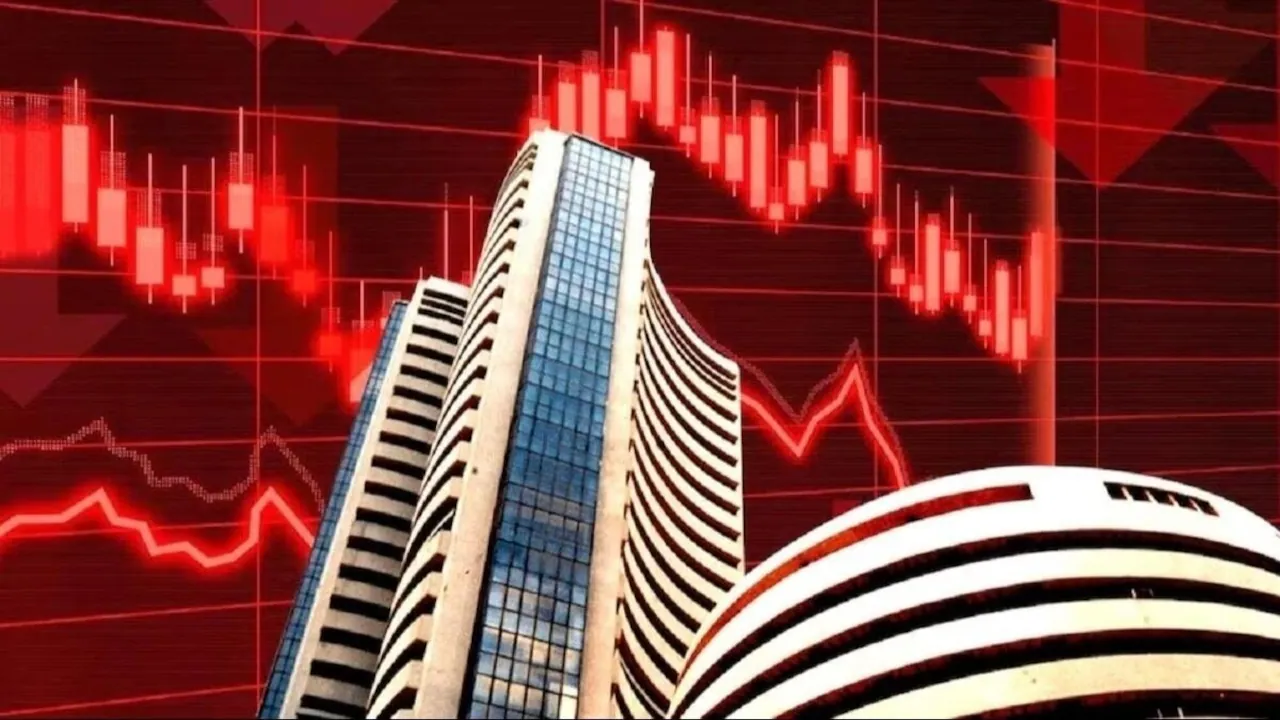
Why Is the Market Falling Today? Sensex Sinks 1,000 Points From Day’s High, Nifty Below 22,400 — 5 Key Reasons Behind the Selloff
Stock Market Today: Sensex and Nifty Witness Sharp Selling
The Indian stock market came under significant selling pressure on Monday, October 12, 2026, as benchmark indices surrendered their early gains and moved sharply lower. The BSE Sensex dropped more than 1,000 points from its intraday high, while the NSE Nifty 50 slipped below the crucial 22,400 level.
The sudden reversal surprised investors who had expected the positive opening to support another recovery session. However, continued foreign institutional investor (FII) selling, rising global bond yields, geopolitical uncertainty and concerns about market liquidity weighed on sentiment.
According to market reports published on Monday, the Sensex was trading around 71,854, down more than 600 points, while the Nifty 50 slipped below 22,400 around midday. India VIX, the market’s volatility indicator, also climbed more than 7%, reflecting increased uncertainty among traders. These figures represent an intraday snapshot and may change as trading continues.
So, why is the stock market falling today despite opening higher? Here are five important factors behind the latest selloff.
1. Heavy FII Selling Continues to Pressure Indian Equities
One of the biggest reasons behind the market decline is the continued selling by foreign institutional investors.
Foreign investors have been withdrawing substantial amounts from Indian equities in recent months. Their selling activity intensified during October, putting additional pressure on benchmark indices and several heavyweight stocks.
According to market reports, foreign investors sold Indian equities worth approximately ₹45,125 crore during the first six trading sessions of October. The selling has added to the already substantial outflows recorded earlier in 2026.
When foreign investors sell large quantities of shares, the increased supply can push prices lower, particularly in stocks with significant institutional ownership.
Several factors can influence these investment decisions, including higher US bond yields, currency movements, global economic uncertainty and opportunities in other international markets.
For India, persistent foreign outflows are particularly important because overseas institutional investors account for a significant share of trading activity in large-cap companies.
Why it matters: Continued FII selling can restrict market recoveries, weaken investor confidence and increase volatility in the Sensex and Nifty.
Investors will closely monitor daily institutional investment data to determine whether foreign selling begins to slow.
2. Rising US Bond Yields Make Equities Less Attractive
Another important factor behind the stock market decline is the increase in global bond yields.
US Treasury securities are widely considered an important benchmark for global financial markets. When their yields rise, investors may find government bonds more attractive compared with riskier investments such as equities.
Higher yields can also increase borrowing costs for companies and put pressure on the valuation of businesses whose expected profits lie further in the future.
This becomes particularly relevant for markets such as India, where foreign investors regularly compare potential equity returns with opportunities available in developed economies.
If US bond yields remain elevated, international investors may become more selective about allocating funds to emerging markets.
Indian shares can face additional pressure when higher yields coincide with currency uncertainty, expensive crude oil and weak global sentiment.
Why it matters: Rising bond yields can reduce demand for equities, increase financing costs and contribute to foreign fund outflows.
Investors will therefore watch US Treasury yields and upcoming economic indicators for signs of whether global financial conditions are becoming more supportive or restrictive.
3. Escalating Middle East Tensions Increase Market Uncertainty

Geopolitical developments in the Middle East are another factor affecting investor sentiment.
Uncertainty surrounding the US-Iran conflict has raised concerns about regional security and the possibility of further disruption to energy supplies and important infrastructure.
Such developments can influence financial markets even when there is no immediate disruption to India’s domestic economy.
Investors generally become more cautious when geopolitical risks increase because the potential consequences for oil prices, inflation, trade and corporate earnings are difficult to predict.
For India, developments involving major oil-producing regions are particularly important.
The country imports a substantial proportion of its crude oil requirements. A sustained increase in international petroleum prices can raise the import bill, increase transportation expenses and place pressure on businesses that depend heavily on fuel.
Higher energy costs may also complicate the inflation outlook and limit the scope for monetary policy easing.
These concerns can affect sectors ranging from aviation and logistics to paints, chemicals and other industries that use petroleum-based inputs.
Why it matters: Geopolitical uncertainty can encourage investors to reduce exposure to risky assets and move towards investments they consider safer.
Market participants will continue to monitor developments in the Middle East and their potential effects on energy prices and global trade.
4. Weak Global Cues and Rising Volatility Hurt Sentiment
Global market conditions also play an important role in determining the direction of Indian equities.
When international investors become cautious, emerging markets can experience selling pressure as funds are reassessed across different countries and asset classes.
On October 12, concerns about bond yields, geopolitical risks and foreign capital outflows contributed to an uncertain trading environment for Indian shares.
The sharp reversal after a positive opening demonstrated how quickly sentiment can change when investors are unwilling to maintain their positions at higher prices.
Another important indicator is India VIX, which measures the market’s expectation of near-term volatility based on Nifty options prices.
During Monday’s trading session, India VIX climbed more than 7% and moved above 15, according to intraday market reports. A rising volatility index generally indicates greater uncertainty about the market’s near-term direction, although it does not predict whether prices will rise or fall.
When volatility increases, traders may reduce their exposure, while investors using borrowed money can face additional pressure to manage risk.
This can amplify price movements during periods of heavy selling.
Why it matters: Weak global sentiment and rising volatility can make investors more cautious, resulting in sudden fluctuations across major indices.
Traders will watch global equity performance, bond yields and volatility indicators to assess whether market conditions are stabilising.
5. Profit Booking and Technical Weakness Add to Selling Pressure
Profit booking is another possible contributor to the market’s sharp intraday reversal.
After an initial rise, some traders may choose to sell their holdings and secure gains rather than wait for further advances. When many participants make similar decisions, selling pressure can increase quickly.
Technical levels also influence short-term trading decisions.
The Nifty 50 slipping below 22,400 has put an important psychological level in focus. Traders often pay close attention to round-number levels because they can influence buying, selling and stop-loss orders.
A decline below a widely watched support level may encourage some short-term traders to reduce their positions, especially when broader sentiment is already weak.
However, technical levels should not be treated as guaranteed indicators of future performance. An index can recover above a broken support level or continue falling, depending on subsequent buying and selling activity.
The broader market picture also deserves attention. While the benchmark indices faced pressure, reports indicated that the Nifty Midcap 100 and Nifty Smallcap 100 were relatively resilient during the intraday decline. This suggests that selling pressure was not equally distributed across every market segment.
Why it matters: Profit booking, stop-loss activity and technical weakness can intensify a decline, particularly when global factors and institutional selling have already made investors cautious.
Sensex and Nifty Today: Which Stocks Are Under Pressure?
The selloff affected several heavyweight companies across different sectors.
Tech Mahindra was among the notable laggards, with its shares falling nearly 4% during the reported intraday session.
Shares of ITC, State Bank of India, Bharti Airtel, Hindustan Unilever, Larsen & Toubro, NTPC, ICICI Bank and Axis Bank also recorded declines of up to around 3% in the reported market snapshot.
However, some stocks moved against the broader trend. Mahindra & Mahindra, Bharat Electronics and Trent were among the companies showing gains during the session.
The difference in performance highlights why investors should examine individual stocks and sectors rather than assuming every listed company is falling at the same pace.
For traders, the next important question is whether buying interest returns to large-cap stocks and whether the benchmark indices can recover their lost intraday ground.

What Should Investors Watch Next?
The immediate outlook for the Indian stock market depends on several domestic and international developments.
Investors should monitor the following indicators over the coming sessions:
Foreign institutional investor flows: A slowdown in overseas selling could help reduce pressure on Indian equities.
US Treasury yields: A decline in global bond yields may improve the relative appeal of emerging-market investments.
Geopolitical developments: Any reduction in tensions could improve risk appetite, while further escalation may increase uncertainty.
Crude oil prices: Changes in international oil prices are important for India’s inflation outlook, currency stability and corporate costs.
Corporate earnings: Quarterly results and management commentary will help investors evaluate whether company profits can support existing valuations.
Nifty technical levels: Market participants will watch whether the index stabilises around 22,400 or experiences additional weakness.
These indicators may help investors understand the market’s direction, but none can guarantee a recovery or predict the timing of a reversal.
Is This the Right Time to Buy Stocks?
A sharp market decline can create opportunities for long-term investors, but falling prices alone do not mean that a stock has become attractive.
Before buying shares, investors should consider a company’s earnings growth, balance sheet, valuation, competitive position and long-term business outlook.
It is also important to distinguish between temporary market weakness and a deterioration in a company’s underlying fundamentals.
Investors with long-term financial goals may benefit from disciplined portfolio allocation and diversification rather than making decisions based entirely on daily index movements.
Short-term traders, meanwhile, should pay attention to volatility, position sizing and their individual risk limits.
Avoid making investment decisions solely because the Sensex has fallen a certain number of points. Market movements can remain unpredictable, particularly when several global and domestic risks occur simultaneously.
This article is for informational and educational purposes only. It is not investment advice.

Conclusion
The Indian stock market faced a sharp reversal on October 12, 2026, with the Sensex falling more than 1,000 points from its intraday high and the Nifty 50 slipping below 22,400.
The five key factors behind the selloff were persistent FII selling, rising US bond yields, escalating Middle East tensions, weak global sentiment and profit booking amid technical weakness.
Together, these developments increased uncertainty and encouraged investors to reduce their exposure to riskier assets.
Going forward, foreign investment flows, global bond yields, crude oil prices, geopolitical developments and quarterly earnings will remain important factors influencing the direction of Indian equities.
Investors should focus on reliable market information, company fundamentals and their personal risk tolerance instead of reacting emotionally to short-term volatility.