


Why Market Is Falling Today? Sensex and Nifty Under Pressure Amid Global Uncertainty, FII Selling, and Profit Booking
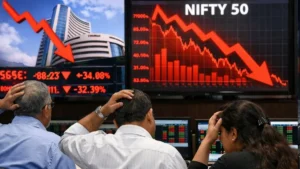
The Indian stock market witnessed significant volatility today as benchmark indices Sensex and Nifty came under sharp selling pressure. Investors across the country are searching for answers to one common question: Why is the market falling today?
The decline in Indian equities comes amid a combination of global and domestic factors, including weak international market sentiment, concerns over interest rates, foreign institutional investor (FII) selling, a weaker rupee, and profit booking after recent market gains. The selloff has impacted multiple sectors, including information technology (IT), banking, auto, and metal stocks.
Market experts believe that the current correction is not driven by a single event but rather by a mix of economic, geopolitical, and valuation-related concerns. While short-term traders are feeling the pressure, long-term investors are closely watching whether the decline presents a buying opportunity. the major reasons behind today’s stock market fall, sectors affected, expert opinions, and what investors should watch next.
Stock Market Falls Sharply
Indian benchmark indices opened weak and extended losses throughout the trading session.
The decline led to:
- Sharp losses in large-cap stocks
- Weakness in banking shares
- Selling pressure in IT companies
- Broad-based declines across sectors
- Increased market volatility
Investor wealth also witnessed a substantial decline as market capitalization of listed companies fell significantly during the session.
Why Is the Market Falling Today?
Several important factors have contributed to today’s market weakness.
1. Weak Global Market Sentiment
One of the biggest reasons behind today’s decline is weakness in global equity markets.
Investors across major economies have become cautious amid concerns about:
- Economic slowdown
- Higher interest rates
- Geopolitical uncertainty
- Weak corporate earnings
Global stock markets witnessed selling pressure after technology shares declined sharply and investors reassessed growth expectations.
Since Indian markets are closely connected with global financial trends, negative international sentiment often affects domestic equities.
2. Concerns Over US Federal Reserve Interest Rates
Another major factor weighing on investor sentiment is the possibility of tighter monetary policy in the United States.
Investors are worried that higher interest rates could:
- Reduce global liquidity
- Increase borrowing costs
- Slow economic growth
- Impact corporate profitability
Recent market movements indicate growing concerns that the US Federal Reserve may maintain a hawkish stance, which has increased risk aversion globally.
Higher US interest rates generally make emerging markets less attractive for foreign investors.
3. Foreign Institutional Investors (FIIs) Continue Selling

Foreign Institutional Investors remain one of the biggest drivers of Indian stock market movements.
When FIIs sell heavily, benchmark indices often come under pressure.
Reasons for FII selling include:
- Global uncertainty
- Better opportunities in developed markets
- Currency concerns
- Risk reduction strategies
Recent data indicates sustained foreign investor outflows from Indian equities, which has contributed to market weakness.
Although domestic institutional investors (DIIs) continue to provide support, they are not always able to fully offset large foreign selling.
4. Rupee Weakness Creates Additional Pressure
The Indian rupee has remained under pressure against the US dollar.
A weaker rupee raises concerns because:
- Import costs increase
- Inflation risks rise
- Foreign investors become cautious
- Corporate margins may face pressure
Currency weakness often leads investors to adopt a defensive approach, particularly in emerging markets like India.
5. IT Stocks Facing Fresh Selling
The information technology sector has emerged as one of the weakest segments in recent sessions.
Investors remain concerned about:
- Slower global technology spending
- Reduced corporate IT budgets
- Economic uncertainty in key export markets
Weakness in global technology shares has also impacted Indian IT companies, contributing to broader market declines.
Since IT companies carry significant weight in benchmark indices, their decline has amplified overall market losses.
6. Profit Booking After Recent Gains
Market experts also point to profit booking as an important reason behind today’s correction.
After periods of strong rallies, investors often choose to:
- Lock in gains
- Reduce exposure
- Rebalance portfolios
Such activity can trigger temporary declines even when long-term fundamentals remain intact.
Many analysts believe part of today’s weakness reflects normal market behavior following recent advances.
Sector-Wise Impact
The market decline has affected multiple sectors.
Information Technology
IT stocks have experienced significant selling pressure due to global technology concerns and growth uncertainties.
Banking Stocks
Banking shares have also traded lower as investors assess economic growth prospects and interest rate developments.
Auto Sector
Automobile companies remain sensitive to inflation, fuel prices, and consumer demand trends.
Metals and Commodities
Commodity-linked stocks have witnessed volatility amid changing global demand expectations.
Midcap and Smallcap Stocks
Broader market segments have also seen weakness as investors adopt a cautious approach toward riskier assets.
Global Factors Influencing Indian Markets
The Indian stock market is increasingly influenced by international developments.
Current concerns include:
Global Growth Slowdown
Economic data from major economies has raised questions about future growth momentum.
Technology Sector Weakness
Global technology shares have faced pressure amid concerns over valuations and future spending trends.
Geopolitical Risks
Geopolitical uncertainty continues to affect investor confidence worldwide.
Rising Market Volatility
Investors are becoming more defensive as uncertainty increases across financial markets.
These factors have collectively contributed to today’s risk-off sentiment.
What Are Analysts Saying?

Market experts believe the current decline reflects a combination of domestic and global challenges.
Key observations include:
- Markets remain sensitive to global news.
- FII activity continues to influence sentiment.
- Interest rate expectations are creating uncertainty.
- Investors are reassessing valuations.
Most analysts emphasize that short-term volatility is a normal part of equity investing.
Is This a Market Crash?
Many investors become concerned whenever benchmark indices fall sharply.
However, experts generally distinguish between:
Market Correction
A temporary decline caused by profit booking, sentiment shifts, or external events.
Market Crash
A deeper and more prolonged decline driven by severe economic or financial problems.
At present, many analysts view the current weakness as a correction rather than a full-scale market crash.
Investors are closely monitoring whether support levels hold in the coming sessions.
What Should Investors Do?
Financial advisors generally recommend avoiding emotional decisions during periods of market volatility.
Important considerations include:
Stay Focused on Long-Term Goals
Short-term market movements often differ from long-term investment trends.
Avoid Panic Selling
Many successful investors view corrections as part of normal market cycles.
Review Asset Allocation
Investors should ensure their portfolios remain aligned with financial objectives and risk tolerance.
Monitor Key Developments
Important factors to watch include:
- FII flows
- US Federal Reserve decisions
- Corporate earnings
- Economic indicators
- Global market trends
Opportunities Emerging from the Correction
While market declines create uncertainty, they can also present opportunities.
Historically, corrections have allowed investors to:
- Accumulate quality stocks
- Improve portfolio positioning
- Invest at more attractive valuations
Long-term investors often use volatility periods to gradually increase exposure to fundamentally strong companies.
Outlook for the Indian Stock Market

Despite current challenges, India’s long-term growth story remains supported by:
- Strong domestic consumption
- Infrastructure investment
- Manufacturing expansion
- Digital transformation
- Economic reforms
However, short-term volatility may continue as investors react to global developments and monetary policy expectations.
Market participants should expect fluctuations while broader trends become clearer.
Conclusion
The answer to the question “Why is the market falling today?” lies in a combination of global and domestic factors. Weak international markets, fears of higher US interest rates, continued FII selling, rupee weakness, IT sector pressure, and profit booking have collectively weighed on investor sentiment.
While today’s decline may appear alarming, many analysts view it as a correction driven by uncertainty rather than a structural breakdown in the market. Investors should remain focused on long-term objectives, monitor developments carefully, and avoid making decisions based solely on short-term market movements.
As economic data, corporate earnings, and global market conditions evolve, the direction of Sensex and Nifty will continue to depend on how these factors unfold in the coming weeks.