


Stock Market Sensex Today: Sensex Falls Over 1,000 Points, Nifty Drops 1.64% — Key Reasons Behind the Market Crash
The stock market Sensex witnessed heavy selling pressure on Thursday, October 8, 2026, as Indian equity markets came under pressure from a combination of rising crude oil prices, foreign investor outflows, higher bond yields and the Reserve Bank of India’s tighter monetary policy stance.
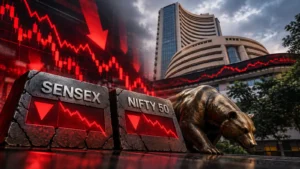
The BSE Sensex closed at 71,593.24, falling 1,045.46 points or 1.44%. The broader Nifty 50 also suffered a sharp decline, ending at 22,231.80, down 371.25 points or 1.64%.
The sell-off marked another difficult session for Dalal Street, with all major sectors facing pressure. Investors are now closely watching crude oil prices, foreign institutional investor activity, interest rates and the upcoming corporate earnings season.
Sensex Today: Major Market Highlights
The benchmark indices started the session on a weak note and selling intensified as the day progressed.
| Index | October 8, 2026 Close | Change |
|---|---|---|
| BSE Sensex | 71,593.24 | -1,045.46 points |
| Nifty 50 | 22,231.80 | -371.25 points |
| Sensex percentage change | — | -1.44% |
| Nifty percentage change | — | -1.64% |
The Sensex touched an intraday low of around 71,333, while the Nifty slipped to approximately 22,180, according to market data.
The decline shows how quickly investor sentiment has weakened as domestic and global risks have increased.
Why Did the Stock Market Fall Today?
Several factors contributed to Thursday’s sell-off. The most important trigger was the combination of higher crude oil prices and the RBI’s hawkish monetary policy stance.
1. RBI Rate Hike Raises Market Concerns
The Reserve Bank of India recently increased its benchmark repo rate by 25 basis points to 5.50% and adopted a more hawkish stance. Investors are concerned that tighter monetary conditions could increase borrowing costs and put pressure on economic activity and corporate earnings.
Higher interest rates can also make fixed-income investments more attractive compared with equities.
For companies carrying substantial debt, higher financing costs can potentially affect profitability. This is one reason why investors closely track RBI policy decisions when assessing the direction of the Sensex and Nifty.
2. Crude Oil Prices Add to Inflation Fears
Another major concern for the Indian market is the sharp increase in international crude oil prices.
India imports a significant portion of its crude oil requirement. Therefore, a sustained increase in oil prices can affect the country’s import bill, inflation, corporate margins and the rupee.
Reports on Thursday indicated crude prices were above the $100-per-barrel level amid geopolitical tensions. The combination of expensive oil and a weaker rupee has increased concerns about inflationary pressure.
Higher fuel costs can also affect transportation, manufacturing and logistics companies.
Foreign Investors Continue Selling Indian Stocks
Foreign institutional investors have remained a major source of pressure for Indian equities.
Reuters reported that foreign investors had sold a net ₹469.9 billion over nine days, taking their annual outflows to a record level of about $30.4 billion.
When overseas investors withdraw large amounts of money from Indian equities, selling pressure can spread across large-cap stocks.
The trend is particularly important for the Sensex because several major index companies have significant weightings in sectors favoured by global institutional investors.
Rupee Weakness Adds Another Challenge
The Indian rupee also remains under pressure against the US dollar.
A weaker rupee can create additional challenges when crude oil and other commodities become more expensive in dollar terms. It can also influence foreign investor returns.
The rupee reportedly closed around ₹96.75 per US dollar on October 8.
Investors are therefore watching currency movements alongside equity markets, bond yields and crude oil.
Sensex Stocks Under Pressure
The sell-off was broad-based, with several heavyweight stocks declining.
Reliance Industries fell around 2.43% during Thursday’s session, adding pressure to the benchmark.
Adani-related stocks also faced selling pressure. Adani Power dropped more than 6% intraday, reflecting the broader risk-off sentiment in the market.
The weakness was not limited to a handful of companies. Sectoral indices across areas such as metals, automobiles, energy, infrastructure, real estate and oil & gas also declined sharply.
Which Stocks Gained Today?
Despite the broader market sell-off, a few stocks managed to outperform.
Among the Sensex and Nifty constituents, Infosys, Tech Mahindra and Axis Bank were among the limited gainers, according to market reports.
Axis Bank was particularly resilient, ending Thursday slightly higher while the broader Sensex dropped 1.44%.
However, the number of gainers remained small compared with the large number of stocks that declined.

IT Stocks Get Some Support
Information technology stocks provided some relative support during the session.
Investors are watching the technology sector closely because the quarterly earnings season is beginning. TCS was among the companies attracting attention ahead of its results.
Corporate earnings could become an important market catalyst over the coming sessions because investors want to know whether companies can maintain profitability despite higher input costs, expensive financing and uncertain global demand.
Strong earnings could provide some relief to the market, while weak guidance could increase selling pressure.
Small-Cap and Mid-Cap Stocks Also Fall
The correction was not restricted to large-cap shares.
Mid-cap and small-cap indices also declined by more than 2% during the session, highlighting the breadth of the selling.
When investors become concerned about risk, they often reduce exposure to higher-beta stocks first. This can lead to sharper corrections in smaller companies compared with large, established businesses.
For retail investors, this is an important reminder that portfolio diversification becomes especially important during volatile market conditions.
Sensex Outlook: What Should Investors Watch Next?
The near-term direction of the stock market Sensex will likely depend on several factors.
Crude Oil
If crude remains above $100 per barrel for an extended period, investors could continue worrying about inflation and India’s external balance.
RBI Policy
The central bank’s tighter stance has become an important market variable. Investors will monitor future comments for indications about whether additional rate increases could be possible.
FII Flows
Foreign investor selling remains one of the biggest challenges for Indian equities. A return of foreign buying could help stabilise the market, while continued outflows could keep benchmarks under pressure.
Corporate Earnings
The September-quarter earnings season is another major factor. Better-than-expected earnings could help companies attract buyers despite weak market sentiment.
Global Markets
US Treasury yields, Federal Reserve policy expectations, geopolitical developments and Asian market performance will also influence Indian stocks.
Is This a Good Time to Buy Stocks?
The sharp correction may make some stocks appear cheaper compared with their recent highs. However, investors should not assume that every falling share has automatically become a bargain.
A stock can continue declining after a major correction if earnings expectations deteriorate or broader market conditions remain weak.
Long-term investors may prefer to focus on companies with strong balance sheets, sustainable earnings, manageable debt and credible growth prospects rather than attempting to predict the exact market bottom.
Investors should also remember that short-term Sensex movements can be highly unpredictable.
What Does the Sensex Fall Mean for Retail Investors?
For retail investors, a 1,000-point Sensex decline can look alarming, but the index represents the combined movement of major companies rather than the performance of every individual portfolio.
A diversified investor may experience a smaller decline than the benchmark, while someone heavily exposed to high-beta or mid-cap stocks could see a significantly larger fall.
Investors should therefore avoid making decisions based solely on one trading session.
Instead, portfolio allocation, investment horizon and individual company fundamentals should remain central to any investment decision.

Final Word
The stock market Sensex suffered a major decline on October 8, 2026, with the index falling more than 1,000 points to close at 71,593.24. The Nifty 50 also dropped 1.64% to 22,231.80, reflecting broad-based weakness across Indian equities.
Rising crude oil prices, foreign investor selling, higher bond yields, rupee weakness and the RBI’s hawkish policy stance have combined to create a difficult environment for investors.
The coming sessions could remain volatile as traders assess global markets, crude prices, currency movements and corporate earnings.
For long-term investors, the current correction may create opportunities in fundamentally strong businesses, but patience and proper risk management remain important. Rather than chasing a quick recovery, investors should track earnings, valuations and broader economic indicators before making major portfolio decisions.